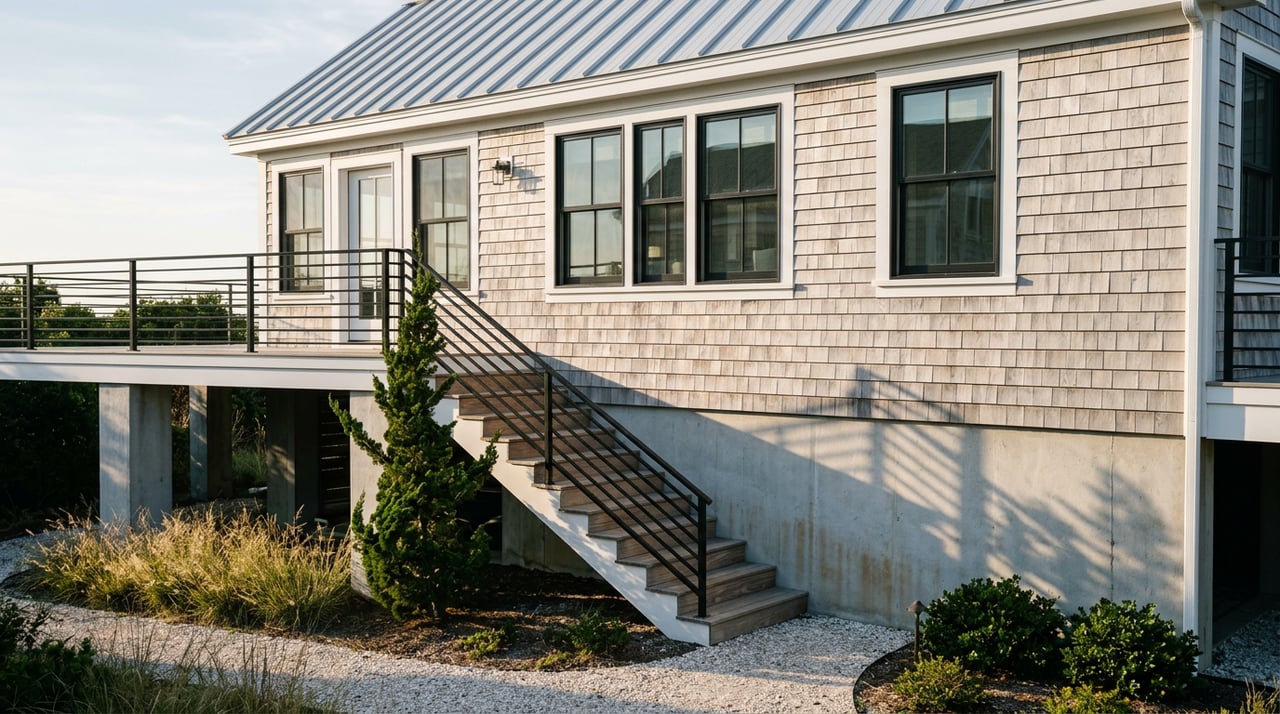
Picture the scene that played out on more than one Bay Head or Mantoloking block this spring. A family with a modest, decades-old cottage near Twilight Lake wants to bump out the kitchen and finally fix the crawlspace that floods every nor'easter. Their contractor tells them to move fast: a new state flood rule is about to make the project far more expensive, and the only way to dodge it is to get a complete permit application in before a hard July deadline. So they rush. They pay for expedited surveys, compress the design timeline, and file weeks earlier than they would have otherwise.
Then, in June, the state quietly moved the deadline a year.
That is not a hypothetical detail invented for effect. It is what actually happened with New Jersey's Resilient Environments and Landscapes rule, known around building departments as REAL, and it is worth understanding if you own an older, non-elevated home in Bay Head and are weighing whether to renovate before you sell, sell as-is, or wait.
What Changed in January, in Plain Terms
On January 20, 2026, the New Jersey Department of Environmental Protection adopted the REAL rule amendments, and for coastal towns like Bay Head the headline change is the flood elevation standard itself. Under the old rules, new construction and substantial improvements in a flood hazard area generally had to sit at the base flood elevation plus one foot of freeboard. That one-foot cushion is written directly into Bay Head's own flood damage prevention ordinance, which has governed construction here since the borough joined the National Flood Insurance Program back in 1971.
REAL replaces that math with something called the Climate Adjusted Flood Elevation, or CAFE, which sets the design flood elevation at four feet above the base flood elevation rather than one. For a house near the bay or ocean, that is the difference between adding a few risers to a stairway and redesigning a foundation.
Old Standard (pre-REAL) | REAL Standard (CAFE) | |
|---|---|---|
Elevation above base flood | 1 foot freeboard | 4 feet |
Applies to | New construction and substantial improvement | New construction and substantial improvement in tidal flood hazard areas |
Adopted | Long-standing NFIP-era standard | January 20, 2026 |
The four-foot number was not the state's opening bid. NJDEP had originally proposed five feet before lowering it in response to public comment, which tells you how contested this rulemaking has been from the start.
The 50 Percent Trip Wire
Here is where it gets specific to the kind of house a lot of Bay Head sellers actually own. Bay Head's flood ordinance defines "substantial improvement" as any reconstruction, alteration, or repair whose cost equals or exceeds 50 percent of the structure's market value. Cross that line and the entire building has to come up to current flood elevation standards, not just the room you touched.
For a modest legacy cottage, that threshold is closer than it looks. A kitchen renovation, a dormer addition, and a bathroom expansion can add up fast relative to an older home's assessed value, especially on a property that has not been touched structurally since it was built. Families who inherit these homes often plan a series of updates over a few years without realizing that the cumulative cost, measured against market value, is what trips the substantial improvement definition, not any single project in isolation.
Before REAL, hitting that 50 percent mark meant elevating to base flood elevation plus one foot. Now it can mean elevating to base flood elevation plus four feet, which is a materially different foundation, a different set of engineering costs, and in some cases a different conversation about whether elevating the existing structure still makes more sense than a rebuild.
The Deadline That Moved
REAL included a grace period for projects already underway. Applications submitted and deemed administratively and technically complete within 180 days of adoption, meaning by July 20, 2026, could still be reviewed under the pre-REAL rules. That deadline is what sent contractors and homeowners scrambling through the first half of the year. It is also the deadline that generated real pushback: the New Jersey Builders Association and the New Jersey Business and Industry Association filed a formal notice of appeal, and a bipartisan Senate resolution sought to repeal the rules outright, according to legal industry summaries tracking the rulemaking.
On May 29, 2026, NJDEP announced it would propose extending that legacy window by a full year, from July 20, 2026 to July 20, 2027. The formal proposal was published in the New Jersey Register on June 1, 2026, with a public hearing held July 7, 2026, and a written comment period that ran through July 31, 2026. The department's stated reason is straightforward: because the underlying standards might themselves be amended during a stakeholder review process, applying a hard 2026 cutoff risked penalizing homeowners and builders for a timeline the state itself might still change.
As of NJDEP's most recent public update, the department has said it will continue applying legacy treatment to eligible applications received on or after the original July 20, 2026 cutoff while the formal extension works its way through adoption. In practice, that means the year-long reprieve is already functioning as policy even before it is finalized on paper. If you are planning a project now, the safe assumption is that the legacy window runs through July 20, 2027, though it is worth confirming current status directly with the department or with the Bay Head building department before you finalize a permitting timeline, since this is a live rulemaking and the specifics can still shift.
What This Means If You're Selling a Legacy Home
If you own an older, non-elevated Bay Head cottage and were told earlier this year that you had to rush a renovation to beat a July deadline, that pressure has eased. You now have a longer runway to plan a project properly rather than filing under time pressure, which matters when the difference between a rushed application and a considered one can be the difference between hitting the 50 percent threshold by accident and structuring the work to stay under it.
It also changes how you think about selling as-is. A buyer who wants to renovate or rebuild an older Bay Head home now has more time to submit a complete application under the pre-REAL standard before facing the four-foot elevation requirement. That is a genuine selling point worth stating plainly in the listing conversation rather than leaving a buyer to discover it on their own. A home that looked like it was racing a regulatory clock in April looks different in a market where that clock just gained twelve months.
None of this changes the fact that any renovation approaching half the home's market value will eventually need to reckon with flood elevation standards in some form. It changes the timeline and the standard that applies, not the underlying reality that Bay Head sits in a flood hazard area and always has.
What This Means If You're Mid-Project
If you are currently planning or permitting work on an older home, the practical step is confirming whether your application would be treated as administratively and technically complete, and by which date. That determination sits with the Bay Head building department and, for state-level flood hazard area approvals, with NJDEP directly. An elevation certificate, which Bay Head's ordinance already requires for new construction and substantial improvement in flood hazard areas, is the document that will anchor that conversation either way.
A Few Straight Answers
Does the extension mean I never have to elevate to the new standard? No. It extends the window during which a complete application can still be reviewed under the older, one-foot-freeboard standard. Projects that miss that window, whenever it closes, face the four-foot standard.
Does this affect my flood insurance requirement? No. NJDEP has been explicit that REAL does not touch FEMA's flood insurance rate maps or the federal requirement to carry flood insurance in a mapped special flood hazard area. Those are separate systems.
Is the July 2027 date final? As of this writing it reflects NJDEP's proposed extension and the department's stated practice of honoring it while the formal rule works through adoption. Given how much this rulemaking has already shifted since its original 2024 proposal, confirm the current date before you build a renovation timeline around it.
Talk to Someone Who Tracks This Because It's Our Neighborhood Too
A regulatory timeline like this one is exactly the kind of detail that gets lost between a builder's estimate and a closing date, and it is exactly the kind of detail that changes what a legacy home is worth to the right buyer. If you are trying to figure out whether to renovate, elevate, or sell a Bay Head home the way it stands today, Suzie & Ed have spent decades in these towns watching these rules evolve one storm and one rule-making at a time. Contact us and let's talk through what your specific property and your specific timeline actually need.