Most homeowners here assume New Jersey's flood construction rules are a new-construction problem. Tear the house down, build from scratch, and the rules apply. Replace a kitchen, rebuild a porch after a rough nor'easter, or finally finish that addition you've been planning since your parents owned the place, and you're outside their reach. That assumption held up reasonably well for years. It stopped holding up on January 20, 2026.
That's the day the New Jersey Department of Environmental Protection adopted the Resilient Environments and Landscapes rule, known around permitting offices as REAL. The rule didn't touch the trigger that decides whether a renovation counts as "substantial" under New Jersey's flood code. It left that alone. What it changed is what happens once you cross that trigger, and for a barrier-island town full of decades-old cottages, that's the detail that matters more than the headline.
The Trigger Didn't Move. The Standard Behind It Did.
New Jersey's substantial improvement test has been in place for years and Mantoloking's own flood ordinance still states it plainly: if the cost of reconstruction, rehabilitation, an addition, or other improvements to a building equals or exceeds 50 percent of that building's market value, the whole structure has to meet current new-construction standards, not just the portion being worked on. A kitchen gut, a full re-side after storm damage, a second-floor addition. Cross that 50 percent line and you're not renovating anymore. You're building to code.
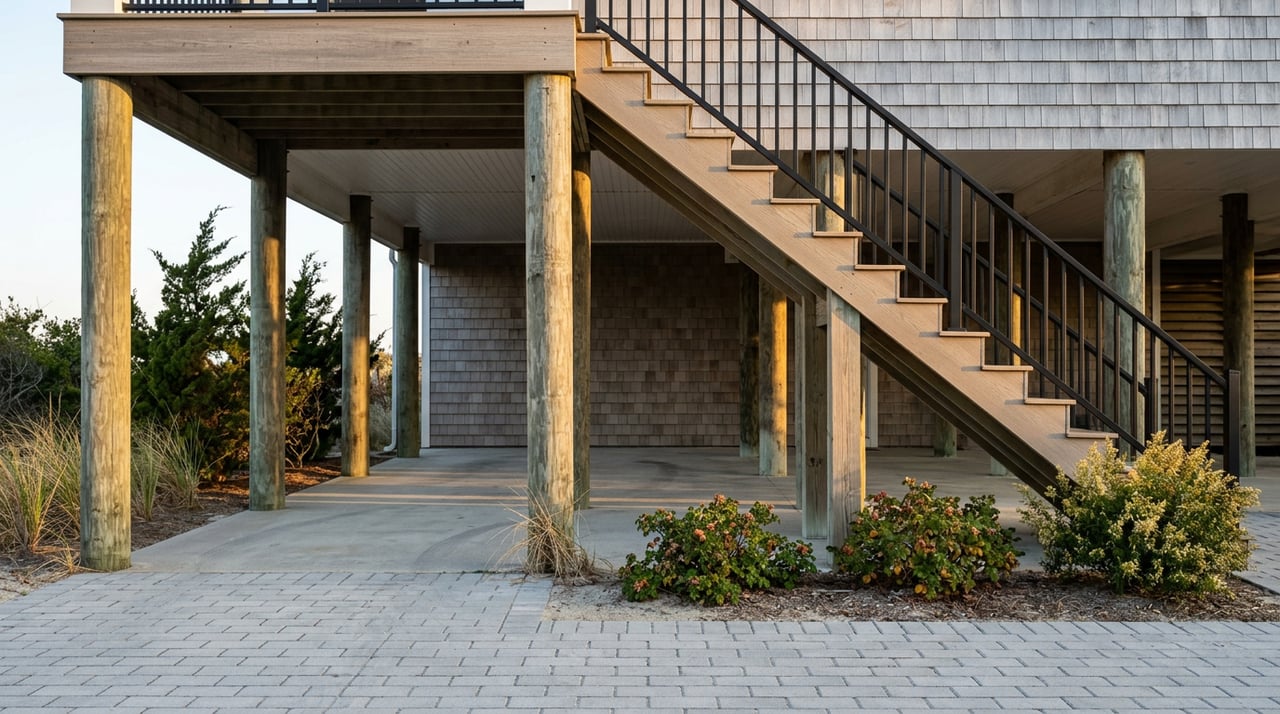
Before REAL, meeting that code in Mantoloking meant getting the lowest floor to at least one foot above Base Flood Elevation, per the borough's own construction requirements. After REAL, the standard climbed to four feet above FEMA's base flood elevation, under what the rule calls the Climate Adjusted Flood Elevation. Several environmental law firms tracking the rule, including Riker Danzig and Day Pitney, confirm the same figure: tidal flood elevations are now climate-adjusted to four feet above FEMA's 100-year flood level, a change that significantly expands which projects fall under it and how much they cost once they do.
Here's the part that gets missed. Nobody redefined what counts as a renovation big enough to matter. They redefined what you owe once you're there. A project that would have cleared the old one-foot bar without much drama can now mean redesigning the whole first floor, re-engineering the foundation, and adding real cost to get to four feet, all because the underlying trigger, the 50 percent test, was never touched. Same door. Different room behind it.
Before REAL Rule | After July 20, 2026 | |
|---|---|---|
Elevation standard once triggered | Base Flood Elevation + 1 foot (Mantoloking's construction requirement) | Climate Adjusted Flood Elevation: Base Flood Elevation + 4 feet |
What triggers it | Repair, addition, or improvement costs at or above 50% of the home's market value | Same 50% test, now paired with the higher standard |
Legacy path | Not applicable | Applications deemed administratively and technically complete by NJDEP on or before July 20, 2026 could still be reviewed under the old rule |
That legacy is open from July 20, 2026 to July 20, 2027. Anyone whose renovation or rebuild permit wasn't already complete in NJDEP's eyes by July 20 is now working under the new number, whether the project was planned before the rule existed or not.
The Elevation Certificate Just Became the Document Worth Getting Right
If the standard behind the 50 percent trigger got stricter, the document that proves where your home sits relative to that standard got more important, too. Under FEMA's Risk Rating 2.0 system, which prices flood insurance property by property rather than by flood zone alone, a home's actual elevation above Base Flood Elevation is the single biggest factor in what the policy costs. Without a surveyed Elevation Certificate on file, insurers price the policy off FEMA's modeled estimate, which tends to run less favorably than a licensed surveyor's actual measurement.
The math is straightforward. A New Jersey Elevation Certificate typically runs $200 to $500 from a licensed surveyor. If it shows your home sitting even a foot higher than FEMA's model assumed, the resulting premium reduction can run $500 to $2,000 or more per year, according to a coastal insurance agency's July 2026 guide. For a seller, that's not paperwork. That's a number a buyer's lender will ask about before closing.
New Jersey has required sellers to disclose FEMA flood zone status and any past flood damage since March 2024. Pairing that disclosure with a current Elevation Certificate does two things at once: it gives a buyer a real insurance estimate instead of a guess, and it tends to keep a deal moving instead of stalling while a buyer's insurance agent chases down elevation data mid-contract.
One more wrinkle worth knowing before you call anyone. Mantoloking participates in FEMA's Community Rating System, which discounts flood premiums based on the borough's floodplain management practices. The borough's own pages don't agree on the current class. Its flood insurance page lists a Class 7 rating and a 15 percent discount. An older flood brochure on the same borough site lists Class 6 and a 20 percent discount. The FEMA CRS program page explains how those classes and discounts work, but the specific number for Mantoloking is worth confirming directly with the Construction Department at 732-475-6983 before anyone builds a pricing assumption around it. Municipal paperwork lags policy. That's true everywhere, and it's true here.
What This Means If You're Sitting on a Legacy Cottage
For a family holding a home that's been in the family for decades and hasn't been substantially touched, the math above cuts a specific way. A cottage that's never crossed the 50 percent renovation threshold is, in effect, grandfathered against the new elevation standard. The moment a future owner's renovation plans push past that threshold, the four-foot rule applies in full. That's not a reason to avoid selling. It's a reason to think carefully about whether extensive pre-sale renovation is the right move, or whether pricing the home to reflect the next owner's likely construction costs, elevation work included, gets you a cleaner outcome than absorbing those costs yourself under the new standard.
For a buyer looking at that same cottage, the calculation runs the other way. An existing NFIP flood policy on the home can often be assumed at closing, which preserves the policy's position on Risk Rating 2.0's 18 percent annual glidepath toward full-risk pricing rather than starting that clock over. Once a policy reaches full-risk rate under RR 2.0, increases stop. Buying the home along with its existing, aging-toward-full-risk policy can be worth more than it looks on paper, and it's a detail a good insurance conversation should happen alongside the home inspection, not after it.
None of this changes what makes a Mantoloking property valuable. It changes what a renovation costs once it crosses a line that hasn't moved in years, and it changes what paperwork a serious buyer or seller needs on hand before making a decision either way.
A Few Straight Answers
Does the new rule apply to me if I'm just replacing a roof or doing cosmetic work? The 50 percent substantial improvement test looks at cumulative repair and improvement costs against the home's market value. Routine maintenance and minor cosmetic work generally sit well under that line. Anything approaching a full renovation, a major addition, or storm-damage repair is worth running past Mantoloking's Construction Department before signing a contractor.
What if my project already had a permit application in progress before July 20, 2026? The rule's legacy provision protected applications NJDEP had deemed administratively and technically complete by that date. If your application reached that status in time, it should still be reviewed under the prior standard. If it hadn't, the current four-foot standard now applies.
Does raising a home automatically lower flood insurance right away? It can, but only once a current Elevation Certificate documents the new height and that data reaches your insurer. The certificate is what turns a physical change into a pricing change.
Rules like this are exactly why buying, selling, or renovating in Mantoloking rewards someone who tracks the fine print for a living. If you're weighing a legacy property, planning a renovation, or trying to figure out what a listing is really worth once these numbers are factored in, Suzie & Ed can walk through the specifics with you. Contact Us.